
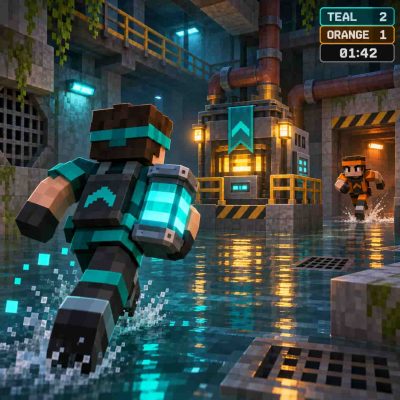
 Two teams spawn on opposite sides of a flooded station. Each has three minutes to recover batteries from maintenance tunnels and bring them back to its generator. Carrying a battery lights up the player’s route with particles, making it easier for opponents to intercept them. When you compare Minecraft servers by the minigames they offer, look at how each one builds on its map. In this match, the server runs the world, plugins enforce the rules, the station’s layout shapes the challenge, and a resource pack helps players recognize objectives and react as the match unfolds.
Server Software Runs the Shared World
A Java Edition server running software such as Paper loads the arena and keeps players in sync as they move, interact with blocks, and use items. It provides an API that plugins can use to respond to what happens in the world. A team can install an existing minigame plugin and configure its arenas, or write a custom plugin when the rules require behavior that existing tools do not offer.
A small community might host a lobby and one arena on the same server. A larger network might run several matches on separate server processes, each with its own arena and round state. Either way, choose a Minecraft version that supports the plugins and assets you plan to use. Test updates with a copy of the map before applying them to the live server.
Plugins Turn Player Actions Into Rules
The match plugin manages the round from the moment players enter the queue. Once enough players join, it assigns teams, gives them their equipment, and starts the countdown. When a player reaches a battery pickup, a plugin listener can respond to that interaction. The plugin checks that the match is active and the battery is available, then records who picked it up. When a carrier reaches the correct generator, the plugin awards a point and updates the scoreboard for everyone.
Multiplayer rules also need to cover interruptions. If a carrier disconnects, the plugin can return the battery to its pickup point after a short delay. If two players reach it together, the plugin must register only one pickup. When time expires, it should stop accepting deliveries before displaying the result. Decide what happens in a tie and whether late arrivals can spectate or must wait in the lobby.
The Map Shapes the Challenge
The station layout determines how the game feels. A wide tunnel with good visibility makes it easier to spot a battery carrier. A narrow service passage offers cover and fewer escape routes. Builders can put a battery where both teams can reach it in roughly the same time, then watch whether one side consistently wins the first pickup during playtests. A route that looks balanced from above can favor the team with fewer ladders or turns.
Once the arena is built, record coordinates for team spawns, pickups, generator zones, and spectator areas in the plugin configuration. Those coordinates connect the scenery to the game rules. If a builder moves a generator, update its scoring zone too. Keep a clean copy of the map. Between rounds, the server can restore affected blocks from saved state or reload the arena from a fresh copy, depending on how much players can change.
Keep match settings separate from arena settings so the same rules can run on a second map. The round length and points per delivery can stay in the match configuration, while each arena supplies its own pickup and scoring locations. That separation lets builders test a shorter tunnel without asking a developer to change how the plugin counts points.
Resource Packs Make Objectives Easier to Read
A Java Edition resource pack can give the battery a custom item model and supply a distinct sound for the plugin to play when a team scores. The plugin still tracks who carries the battery and decides when a delivery counts. The pack gives players cues they can recognize mid-match. Use different shapes, labels, and colors so players can tell the generators apart at a glance.
A server can offer its pack when players connect and can require it if the game relies on its assets. Test that a fresh client can download and apply it. If the pack is optional, give players usable defaults such as named items, signs, and scoreboard messages. Someone who declines the download should still know what to collect, where to take it, and how much time remains.
Test the Whole Round With Players
Run several matches in a row with people who have never seen the map. Watch where they hesitate, whether they know when they have scored, and what happens when someone leaves during the countdown. Try simultaneous pickups and deliveries just before the timer expires. Then start another round and check that scores, inventories, batteries, and gates return to their starting states. A reset bug can take two rounds to show up.
Use the playtest to decide which piece needs work. If players reach the generator and score without realizing it, improve the sound or scoreboard feedback. If one team repeatedly gets there first, measure its route and adjust the layout. If deliveries count twice, fix the scoring rule. When all four pieces agree about what happens in a round, players can concentrate on beating the other team.